Two layers · Surface / sealant
PET / PE
A simple laminate to consider when a dedicated barrier layer is not required.
Review: Product sensitivity, film thickness, sealing and the intended shelf life.


CUSTOM PRINTED FLEXIBLE PACKAGING
Your product. Your artwork.
Film selected with production in mind.
For supplement powders, drink mixes and food applications. We help review the material structure, print layout and roll specifications for your product and packaging equipment.
Third-party test report with every batch
*Transit time is additional. Project timing is confirmed with your order.
UNDERSTAND YOUR MATERIAL OPTIONS
A laminate combines materials with different jobs. Choose the functions your product needs, then build the structure around them.
Outside of the pack
Product inside the pack
The basic arrangement is an outer surface, any functional layers needed, and a product-facing inner layer. A barrier or reinforcement layer is added when the application calls for it.
Four functions do not mean every pack needs four layers. A material can perform more than one job, and a film can contain several coextruded layers. More layers alone do not make a better pack.
The same principles apply to rollstock and premade pouches. Pack shape, sealing and filling requirements still need their own review.
Explore structure examplesPA nylon can also serve as an outer film in some vacuum-packaging structures. The layer’s role depends on the complete design.
Transparent barrier-coated PET, such as AlOx-coated PET, is another option to discuss. An aluminum-oxide coating differs from the metallic coating on VMPET.
Reinforcement addresses the body of the pack. Leakage also depends on seals, product compatibility and the filling process, so adding PA does not by itself make a pack leakproof.
Specialty PLA- or PBAT-based films need a separate review of barrier, sealing and heat limits. Food-contact suitability is confirmed for the selected material grade and intended use.
UNDERSTAND THE SEAL
In a PE-to-PE seal, heat and pressure fuse the two inner layers. Cooling sets the bond.

Match the film to the seal format. A fin seal joins inner face to inner face. A lap seal joins an inner face to an outer face, so those surfaces must be compatible for sealing. Other films may use CPP or a different sealant.
Confirm the sealing window on your line. Temperature, contact time and pressure work together. The jaw setting is not the temperature at the PE interface; film construction and line speed affect heat transfer.
Research on LDPE and LLDPE sealant films, polymer-chain diffusion in heat seals, and technical background on stick-pack fin and lap seals. These explain the principles; they do not specify settings or validate a particular supplied film.
KEEP PRINT AND CUT IN STEP
A printed eye mark gives the packaging machine a position reference. The sensor reads it; machine control aligns the film with sealing and cutting.

Give the sensor a clear reading track. The mark must be distinguishable from its background and any graphics along the sensor’s path. Black on light film is one example; the right color, size and sensor setup depend on the material and equipment.
Keep the print repeat consistent. Confirm mark spacing, mark-to-artwork position and the intended seal and cut locations. Film flutter, glare, weak contrast or competing graphics can interfere with detection. Evaluate the printed film on the intended line.
SICK on registration-mark design and contrast sensing, SICK on print-mark registration and web-motion control, and Banner’s registration-mark sensor guide. Setup, signal behavior and correction methods vary by sensor and packaging machine.
START WITH YOUR PRODUCT
Share the product and process first. We can then compare structures, confirm specifications and plan sample evaluation.
Powder, liquid or oil; ingredients, alcohol content or acidity where relevant; and the amount in each pack.
Moisture, oxygen, light or aroma. Include target shelf life, storage conditions and distribution requirements.
Ambient filling, hot fill, retort or frozen storage. Share temperatures, times and equipment details if known.
Clear or opaque, paper texture, matte or gloss. Include opening preferences, brand goals and budget.
9 examples to explore
Compare what each combination adds. These are starting points for a discussion about your product, shelf life and filling process.
Two layers · Surface / sealant
A simple laminate to consider when a dedicated barrier layer is not required.
Review: Product sensitivity, film thickness, sealing and the intended shelf life.
Two layers · Surface / sealant
An option for gloss or matte presentation, with a CPP inner sealant.
Review: Barrier needs and how the complete film responds to your machine’s heat and speed.
Three layers · Surface / barrier / sealant
Adds a metallized barrier layer to a PET surface and PE sealant.
Review: Finished-laminate barrier data, shelf-life needs and cost against a foil option.
Three layers · Surface / barrier / sealant
A foil-based option for products needing strong oxygen, moisture and light protection.
Review: Foil gauge, handling, seal performance and an opaque appearance.
Four layers · Includes reinforcement & foil
Combines a PET surface, nylon reinforcement, foil barrier and PE sealant.
Review: Liquid or oil compatibility, pack size, handling loads and seal integrity.
Four layers · Includes reinforcement & metallized film
Adds nylon reinforcement while using metallized PET as the barrier option.
Review: Required barrier performance, mechanical strength and seals for your formulation.
Transparent barrier · Layer count varies
For discussing oxygen protection while keeping the product visible.
Review: The complete film design, moisture protection and barrier performance at the expected humidity.
Heat processing · Structure specified by process
A foil-based candidate with a retort-grade CPP sealant, specified for the required heat process.
Review: Filling and sterilization temperature, time and pressure, adhesives and seals. Standard PE or CPP grades are not automatically interchangeable here.
Three layers · Paper surface / foil / sealant
Combines a paper outer appearance with a foil barrier and PE inner layer.
Review: Surface feel, print, natural batch variation and whether an extra outer film is needed.
Read structures from the outside to the product side. The examples identify material families, not finished specifications. Layer order can vary. Grades, thicknesses, adhesives, processing and seals determine the final performance. Compare oxygen and moisture transmission on the complete structure under the same test conditions, and evaluate samples on the intended line.
You do not need to arrive with a finished laminate specification. Tell us about your product, preferred pack and production plan, and we’ll help review the options.
For general background: Kuraray on EVOH and moisture protection, Toray on transparent barrier-coated films, and Profol on retort sealant films. These references describe material functions; they are not test reports or specifications for Encap-supplied film.
Discuss recycling or composting goals when selecting a structure. A paper layer, EVOH or PLA by itself does not establish recyclability or compostability of the whole pack.
BUILT AROUND YOUR APPLICATION
Once the material is selected, confirm dimensions, roll configuration and sealing requirements with your equipment team.
We review film dimensions, sealing and handling requirements against your equipment and production plan.
Available options include foil and metallized laminates, clear structures, matte and gloss finishes, soft-touch effects and easy-tear options. Availability and the final structure are confirmed for your application.
Choose the surface appearance that fits your brand.
Review film and coating options using physical samples.
Discuss tear performance alongside the selected structure.
REVIEW BEFORE YOU COMMIT
Free unprinted blank film is available for evaluation.
Our team can coordinate trial runs alongside Pure NSM to assess film handling and sealing. Or discuss sample requirements for your own production line or chosen co-packer.
Blank-film trials assess material behavior. Custom print registration requires separate evaluation. Sample quantities, shipping and any trial charges are confirmed by project. Free blank film does not mean free shipping or free trial services.
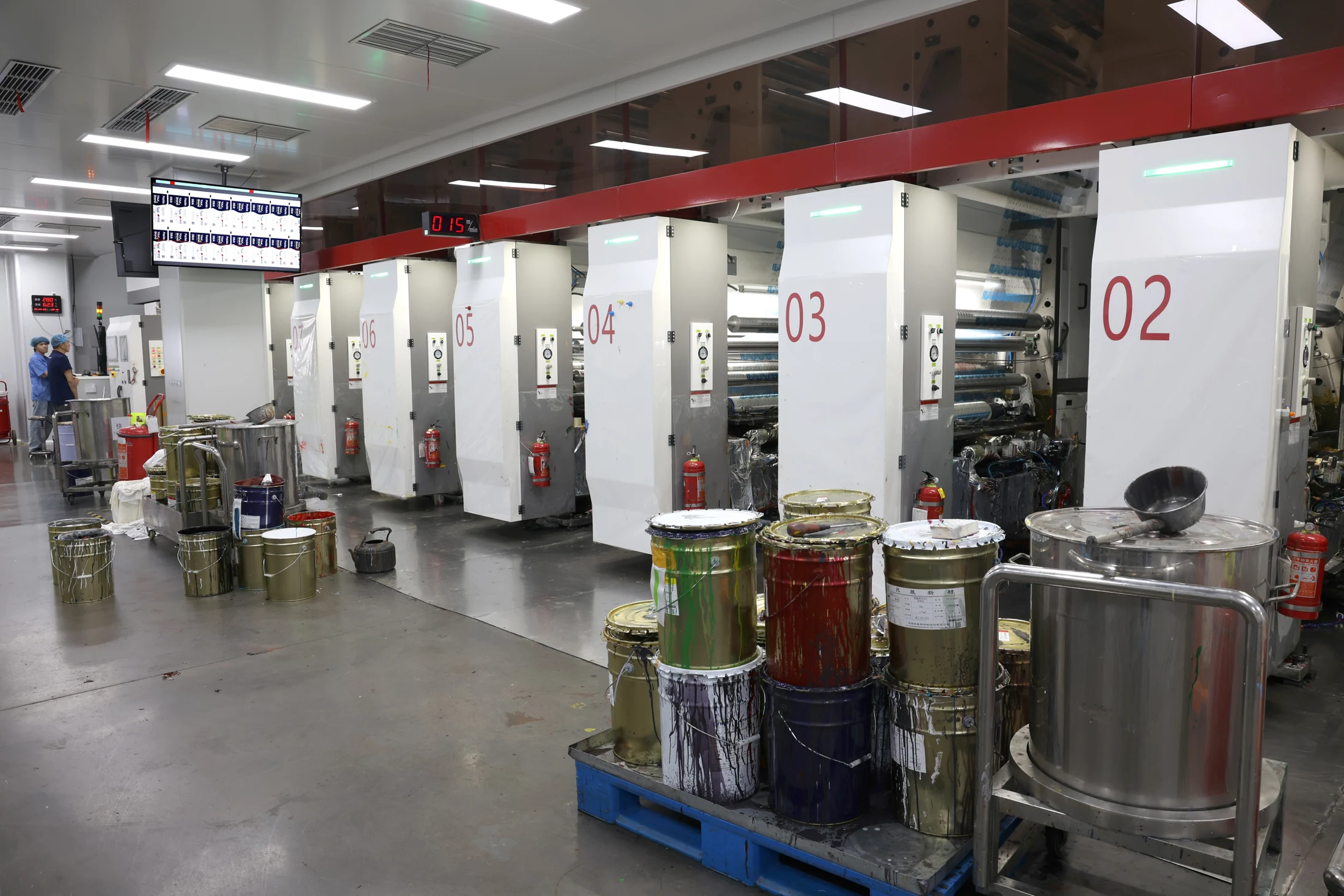
FOOD-CONTACT SAFETY & QUALITY
Every batch of rollstock comes with a third-party test report. Documentation is tied to the relevant material and testing scope.
Review the tests performed and the reported results for the supplied batch.
Relevant supplier statements and selected sample tests support application-specific material review.
Certification coverage is confirmed for the manufacturing facility selected for your project.
Explore testing & material records
Clear scope matters. A test report applies to its stated sample, tested portion and conditions. Selected food-contact tests are not a blanket approval of every product or application.
ORDER PLANNING
100 kg minimum. More competitive pricing above 500 kg for a single batch with the same specification and artwork. Different designs or batches cannot be combined.
Typical production is 30 days after artwork approval. Courier, air and sea freight options are discussed against your target production date.
Material, quantity, print tooling, finish and delivery requirements are reviewed in your quotation.
BEFORE YOU ORDER
Start with your product, protection needs, filling process and preferred appearance. Review the layer functions and structure examples, then share your requirements with us. The same material names can describe films with different grades, thicknesses and performance, so we confirm the complete specification and evaluate samples.
No. You can purchase film for your own equipment or your chosen co-packer. If you choose production support, our team works on site alongside Pure NSM, collaborating from planning and setup through production.
Yes. Share your product, packaging format, quantity and target date. Any equipment specifications or an existing film sample will help us review suitable options.
Our standard rollstock minimum is 100 kg per specification and artwork design. Special structures, finishes and tooling are confirmed in your project quotation.
No. This is the typical production time after artwork approval. Transit is additional and depends on the agreed delivery arrangements.
It helps evaluate film handling and sealing on the selected equipment. It does not validate custom print registration, which needs separate evaluation.
Your product, estimated quantity, dimensions if known, artwork details and target production date. If you are unsure about a specification, tell us and we can help.
YOUR NEXT PRODUCTION RUN
Share what you know. We’ll help with the details.